Specific criterions of speciesist humiliations: (1) designation as a “food” resource

Fragment: Why is it important to highlight the specifics of an oppressive system: The structure of denial and negation mostly serves to “legitimize” oppression/injustice, and these kinds of ‘humilitation’ take specific forms and function as instruments of oppression. In the case of speciesism the title as: food i.e. being designated to be the food the oppressor “nourishes” him-/herself from, plays a most tragically remarkable role.

animal_sociology_gruppe_messel_1a

Where intersections turn crossroads: shared factors of oppressive functions, separating markers. Seeing what makes each case unique might help putting the puzzles together.

If you keep relegating animality into reductive frameworks while doing animal advocacy work, your activism isn’t really aware of the scopes of ethical, political, sociological interfaces between nature-animality-humanity …

Messel; Nonhuman-inclusive; Animal Autonomy

applying_what_frameworksWhere intersections turn crossroads: shared factors of oppressive functions, separating markers. Seeing what makes each case unique might help putting the puzzles together.

With all the intersections (and what I’d additionally call the interfaces equally) given, there are also clearly factors that in the end of the day categorically separate one system of oppression from another, and in the case of the functionalities of nonhuman animal oppression we have these unique markers that we must address in order to analyse what exactly this phenomenon ‘speciesism’ is.

The mechanisms of sexism, racism, ableism and basically any way in which living individuals are actively and passively negated can be understood in their specific manifestations, that are specifically experienced by the individuals and groups who become victimized and who are affected. Intersectionally in terms of nonhuman oppression we would need the factor of having experienced being designated the role of actual “food” for example in a completely righteous manner, not in an ambiguous state. We can’t deny that nonhumans know what they are the victims of, that would be highly biologistically speciesist. The complexity of oppression is fully known by the affected nonhuman individuals and groups.

That being said one must add that it is true that life is being negated in its dignity in any cases where oppression takes place. It would be problematic to draw lines of known -isms and for example overlook individual cases of denial of the right to life and dignity.

When we involve the complex-of-nature for example we are going to get rather into understanding how life overall is being classified and negated in a fundamental way, and that not just an oppressive class, but the individual enactor of destructivity is the thinking and acting agent that should be taken a look at (after all ending destructivity is an emancipatory process at its best).

If a nonhuman animal that is considered to be a “farmed animal” crosses a street where people walk and don’t expect him/her, and if a  human who is oppressed crosses a street, we categorically have the scenario that no matter what the nonhuman animal will be considered a lower life in the specific sense of a food provider and a utilitarian-type “resource”. The nonhuman will be excluded from the human race – which is a problem in itself – but be be relegated in the realm of “nature”, which is the sort of “antagonist” to human”” existence. This makes up speciesism and such type of specifics need to be analysed in all detail.

When activists solely focus on nonhumans, they tend to leave nonhumans within the biologistic speciesist paradigm. Intersectionality gets us away from biologist patterns to a partly ambivalent extent. Yet what makes speciesism speciesism, and what makes oppression oppression, and what makes humanity in total to have lived on a specifically nonhuman animal and nature oppressive basis and on other oppressive bases that affect any life in any possibility? I want to face human-created histories in terms of all existent injustices equally.


Aspects of an ecocentric sociology: Ressources; Cultures, Empathy, Borders

social_destructivity_1a

The social destructivity exerted by our ‘humanity’ towards ‘animality’ (and all nonhuman life) is the fundamental ethical problem, not the question of indirect damages caused to “our” ressources and interests by this destructive behaviour.

Gruppe Messel, Tierautonomie / Animal Autonomy

ethical_lifestyles_and_cultures_1a

Veganism is really ‘one expression for a holistically ethical lifestyle’, cultural histories give us indications and clues about the histories of such.
Seeing it from this point of view gets us more into ethical pluralities and deeper layers of non-anthropocentric thought.

Gruppe Messel, Tierautonomie / Animal Autonomy

What is EMPATHY? We are rather in a constant process of learning from each other, a failed or active information exchange. There is no constant positive affirmation, even in doubt we learn. We can’t chose – we learn something from one another. All existence does.

Which threshholds do what kind of societal groups not like to cross and be CROSSED by others?
And are different parameters for discussing angles of problems recognized or do perspectives have to be narrowish to seem intelligeble I wonder. #ecosociologies

Inhibiting normalcies within activism

besita_obscura_12_farangis
Activism as a practical focus

  • on the marketing of ready made vegan products
    plus
  • vegan cooking
    plus
  • ones public physical self-presentation as a vegan example

seems to take quite a space in the iconography created by some vegans. It transports a consumerist image to me.

This seems to vary though with current cultural habits, normalcies and practices, as in some places the focus tends to be more on helping and supporting nonhumans and human individuals/groups as a form of visible, political and standardly represented plant-powered activism – such as generally in Turkey and Brazil for instance and in the Black vegan movement and the VegansofColor movement in the US.

In general also I observe the obsession with photographing oneself in public at activist events or activivism-related opportunities. This in itself seems to count as a proven and valid form of expected social integration and a trustworthy marker of activist efficacy. This also requires that you are able-bodied and don’t suffer from any social phobia, it also requires you to accept social patterns of the peer group dynamics you are partaking in.

The problem is about the norms that are created and upheld (…) even with a broader, informed knowledge. Such norms create spaces of social divergence for those who decide to communicate differenlty, also by chosing other forms of expressing their basic political positions.

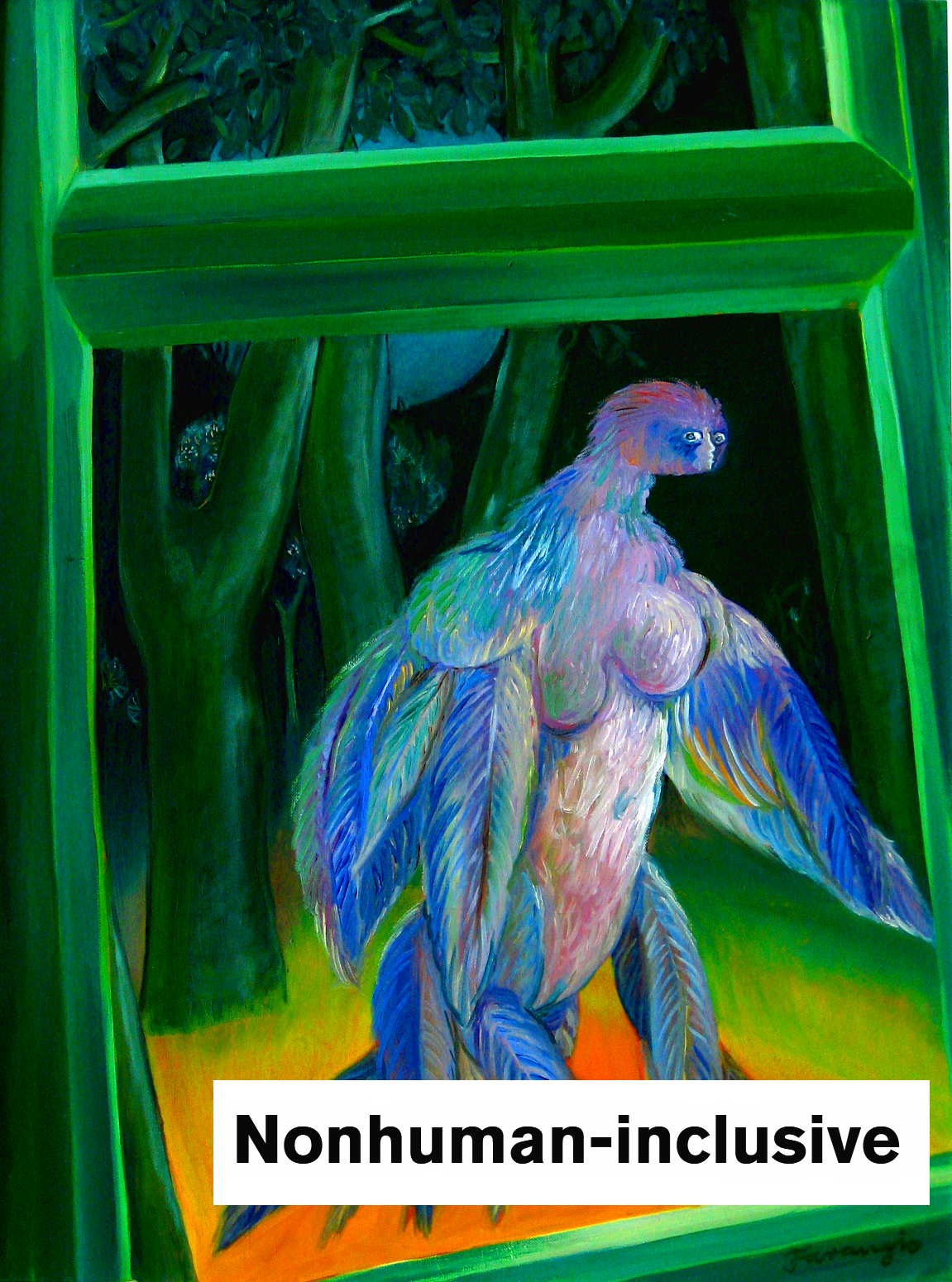
Image … of a Bestia obscura, by Farangis.de.

Nonhuman-inclusive

farangis_yegane_0599_2c

Nonhuman-inslusive

The term ‘veganism’ describes the ethical and practical exclusion of any animal- and animal derived product or animal-involving procedures/exploitation utilized to serve human interests. It does not say or indicate yet how nonhuman animals should be implied actively into any framework that implies humans/human societies, as a solution to the existent predominant catastrophic human-animal relation. How nonhumans can and should be included and reached out for, be addressed, implied constructively in a way that confronts the ‘animal question’ with due justice, in n toher words: the state of positively dwelling together is not so much and only indirectly put forward.*

Similalry ther term ‘speciesism’ describes the condition of ethical exclusion, now on a basically sociological level. It describes foremostly the biological categorisation yet inasmuch also other forms of categorization – such as religion, philosophical, scientific, etc. – of arbitrary derogative barriers set up by humans/’human cultures and civilization’ towards nonhuman animals.

We thought now to express the direct inclusionary level by a simple term which can be used practically and applied as a scheme to test any settings, condition … to check any given situative constellation for its nonhuman-inclusiveness!

This is about expressing an idea:

For checking anything for its nonhuman-inclusiveness you logically have to open up perspectivcs of how your view of nonhumans can be reasonable and ethically complete, appreciative and open-minded.

You can thus explicitly create, observe, discuss, design, conceptualize each and every aspect of human life in a nonhuman-inclusive approach.

Sounds perhaps too practical and maybe this seems to short a description of our idea, but we find it a helpful angle in our activities.

It should be added that our nonhuman-inclusive approach can be extended into a nonhuman-considerate direction where a seeming absence of nonhumans can be affirmative of nonhuman interests also indirectly, by a decided avoidance of promoting human concepts which openly or subtly suppress nonhumanity and nonhuman animals, but this will be discussed in a seperate, later post.

* This becomes clear e.g. in veganic projects, which 100 percent represent the vegan idea, yet exclude the question of animal life in a proactive form. Veganic projects don’t imply space for nonhuman animals to be involved in a just yet existentially directly present way.

Being radical antispe …

animal_sociology_gruppe_messel_2csmall

A very rough expression of a feeling in regards to radical antispeciesism facing a conflict of being stuck in the middle of biologistic ‘animal lovers’ and nonhumanity-oblivious social justice clusters … :

If social justice work categorically excludes animal bodies, it’s questionable to my point of view. Saying this I don’t mean the type of implication that bases on “mild” speciesist, biologistic views of animality.

I come myself from a ‘mixed’race’ background and I have grown up in a country where you would face exclusion if you did not fit into the right image of the virtual “false-ethicity-person” and the right klischee going along with that. It’s not like all foreigners or poc or mixed-race individuals were equally accepted or discrimnated against. Much was and is dependent on the social function society ascribes you to take in the place you live.

Seeing a lot of people who come from socially comparable backgrounds such as mine working rightly for social justice, I wonder why the majority misses out on antispeciesist intersectionality though? To my point of view social justice can’t just evade questions of how concepts about animality and nature have been constructed in our societies. How can social justice turn an oblivious eye on zoocide and ecocide, when exactly those are facts that result from the very same foundations on which other oppressive systems thrived, and when those facts are taking place are all around us?

I believe that justice for humanity can hardly base on the oppressive constructs of animality and nature anymore, without being prolonged types of injustice.

Gender and animal sociology, snippets

mother_2cccc
Genderroles, animal sociology and „instincts“
We want to liberate from gender roles for human parenting, yet we assume that nh-animals only lapsed with seahorses, earthworms, kiwis, etc. and their genders and procreational evolution.
What exactly are “motherly instincts”, and what are “fatherly instincts”? Do we even see fathers in the prisoned life nh-animals are stuck in by us? How do we know what would be the typical behaviour for nh-animal families and their social networks in their own chosen contexts?

mother_2b
Defining Nonhumans as ‘INSTICNTUAL’ is species-derogative and biologistic …
Please quit reducing nonhuman motherhood to “maternal instincts”.

interfaces
Instead of shrinking everything about nonhuman animals to “instinctuality”: I can represent nonhumans by discarding speciesist ascriptions, and frame them with liberated / autonomous perspectives, as mutual interfaces.

Antispeciesism is not necessarily what speciesism isn’t

antispe_and_speciesism

People who consider themselves to be antispeciesists mostly don’t see or don’t want to discuss the links between: ecocide, genocide and zoocide. The term and notion of a zoocide does not even exist for most in that correlation in their terminology. Many still hold the same assumptions about animality that base on ethical histories and theories within philosophy, religion, natural sciences that are the very cause of speciesism. Loving nonhuman animals at the same time as quoting biologist data for instance and instead of coining own liberated terms,
antispeciesism today does not equal consistent antispeciesist thought so far. It helps with the symptoms but harms at the same time, by cementing nonhumans into a slippery slope concept of freedom and dignity pushed upon them.

Rights claimed only go as far as theories about nonhuman animals are compatible with it. Not breaking with the power of human definition, antispeciesism today misses to acknowledge that nonhuman animals are oppressed in the first place in their very own qualities of who they are, in their identities independent of humancentric frameworks. And that happens parallel to them being bereft of their physical freedom and integrity, parallel to being tortured and murdered and physically objectified to a human will to cause them the ultimate pain … .

spegiesism_is_like

Outside looks on cultures of nonhuman animality

being_an_animal_1a

Confining animality
(the actual ‘being-an-animal’)
into biology-centered frameworks
still poses an unsolved problem
within AR.

Gruppe Messel / Tierautonomie /Animal Autonomy

How does someone view other animals:

Changing the images society and people have constructed in their thinking and in their outlooks about animality takes more than our vegan lifestyle, more than campaigning for final goals. It needs that we straightforwardly postulate (emancipation!) different viewpoints, different angles of viewing the world’s animal individuals, their socio-ecological contexts, and their cultures in the given oppressive contexts.

From a biology-centered viewpoint people/society want to assume that nonhuman animals don’t decide, don’t think, don’t reason, don’t experience oppression in contexts of their evolutionary cultures. A biology-centered viewpoint compares animality with humanity and pinpoints certain physical functions as markers for the ability to ‘reason/think’. Philosophy again constructs a notion of borders within reasoning around the human self or certain human selves.

It takes more than animal liberation on the physical level to change and widen the perspectives on human-nonhuman conflicts, quite obviously. Saying this, nonhuman animality isn’t solely a recipient of oppression exerted by human beings in their cultures; in contrast I believe that the human forms of oppressing nonhuman animality has a lot to do with the agency of animality on levels our society typically ignores, levels our society might not have tried, been able or willing to name, but these levels are parts of the animal-nature-continuum and the big scope of its cultural wisdom, richness, smartness, cultivatedness, decisiveness … .

Just try it, you might very well know how cultures aren’t restricted to humanity – that we all need to build new perspectives on animality, animal individuals and on the entire social codes built between humanity towards animals. Try and ask your vegan friend what she/she makes of establishing an emancipated view (in regards to language, philosophy, and common sense) on the human-animal conflict and human-animal interaction. I assume she/he still thinks that it’s perfectly fine to keep the cornerstones of speciesism in the “active-mode” (i.e. religious speciesism, philosophical speciesism, speciesism in the natural sciences, sociological speciesism, legal speciesism, cultural speciesism, aesthetical speciesism, speciesism in all segments of how we define the scope, meaning, content, value, sense of life) and that she/he will try to not seek for new ways of ending the ‘massmurder taking place on the biological argument’, the individual degradation on the level of cultural difference between speciesists and nonhumans. They will however not be able to accuse you of anthropocentrism, because they can’t rule the aspect of animal-cultures-on-more-than-the-biological-level out.

Religion and Science both have created oppressive constructs about Nature

alternatives

Alternatives in the oppression of nature-as-a-context-of-living-beings:

a.) “dominium terrae” [bible, says humans should rule and subjugate the world]

b.) “nature-as-a-resource” [the endeavours in the natural sciences have always been going along with generating economic benefits for any oppressive human castes]

Both spiritually in most religions, and philosophically in most sciences: Nature is seen as a means, a tool, a “material” that can be reduced in its autonomous sense and value.

Gruppe Messel / Tierautonomie / Animal Autonomy